Chin Tseng
CS PhD Candidate
5th year PhD student in Computer Science, specializing in data visualization and human-computer interaction. Currently on the job market seeking opportunities in industry.
About Me
I’m Chin Tseng, a Ph.D. student in Computer Science at the University of North Carolina at Chapel Hill, advised by Prof. Danielle Szafir. My research lies at the intersection of human–computer interaction (HCI), information visualization, and human perception, with a focus on how people interpret and reason about complex data through interactive visual representations. I study how visualization design choices—such as color, shape, and redundancy—affect users’ ability to analyze categorical data, particularly as visual and cognitive complexity increases. Through large-scale empirical studies, I investigate how perceptual and cognitive mechanisms shape user performance, and how widely used design heuristics hold up in realistic, multi-category settings. Beyond controlled experiments, I am interested in translating empirical insights into interactive systems and design tools. My work includes building data-driven visualization tools that support designers and analysts in making informed encoding decisions, as well as developing interactive components for real-world analytics workflows. More broadly, I am motivated by HCI questions around how interfaces can better align with human perception, cognition, and decision-making. My goal is to contribute empirically grounded methods and systems that bridge theory, design, and practice in human-centered computing. Looking forward, I am interested in human-centered interface design for AI systems, focusing on how interaction and visualization can help people interpret, verify, and reason with model-generated outputs. Before my Ph.D., I earned my M.S. in Computer Science from NYU and my B.S. from National Tsing Hua University in Taiwan, with an exchange year at TU Dresden. I also enjoy building interactive visualization systems in practice, having worked as a research intern at Epsilon and as a software engineer in industry.
Research Interests
Recent Publications
View AllRedundant Is Not Redundant: Automating Efficient Categorical Palettes Design Unifying Color & Shape Encodings with CatPAW
Chin Tseng, Arran Zeyu Wang, Ghulam Jilani Quadri, Danielle Albers Szafir
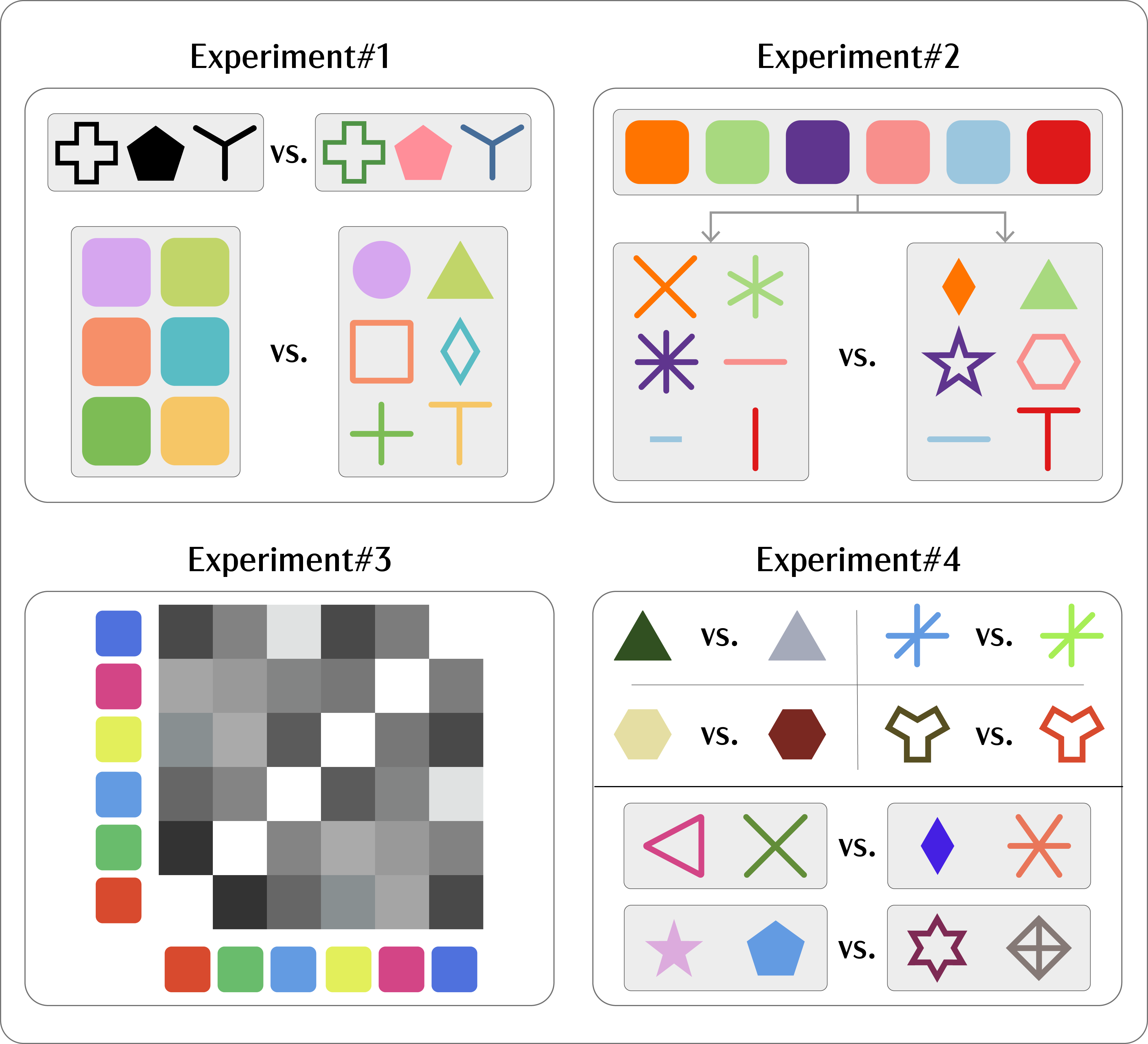
This paper systematically evaluates redundant color–shape encodings in multi-class scatterplots and shows that redundancy is not universally beneficial. Instead, its effectiveness depends on category count and specific color–shape pairings, with the strongest benefits appearing at moderate category numbers. We operationalize these findings in CatPAW, an interactive tool that generates empirically optimized categorical palettes under user-defined constraints.
Uncovering How Scatterplot Features Skew Visual Class Separation
Chin Tseng*, S. Sandra Bae*, Takanori Fujiwara*, Danielle Albers Szafir (*equally contributed)
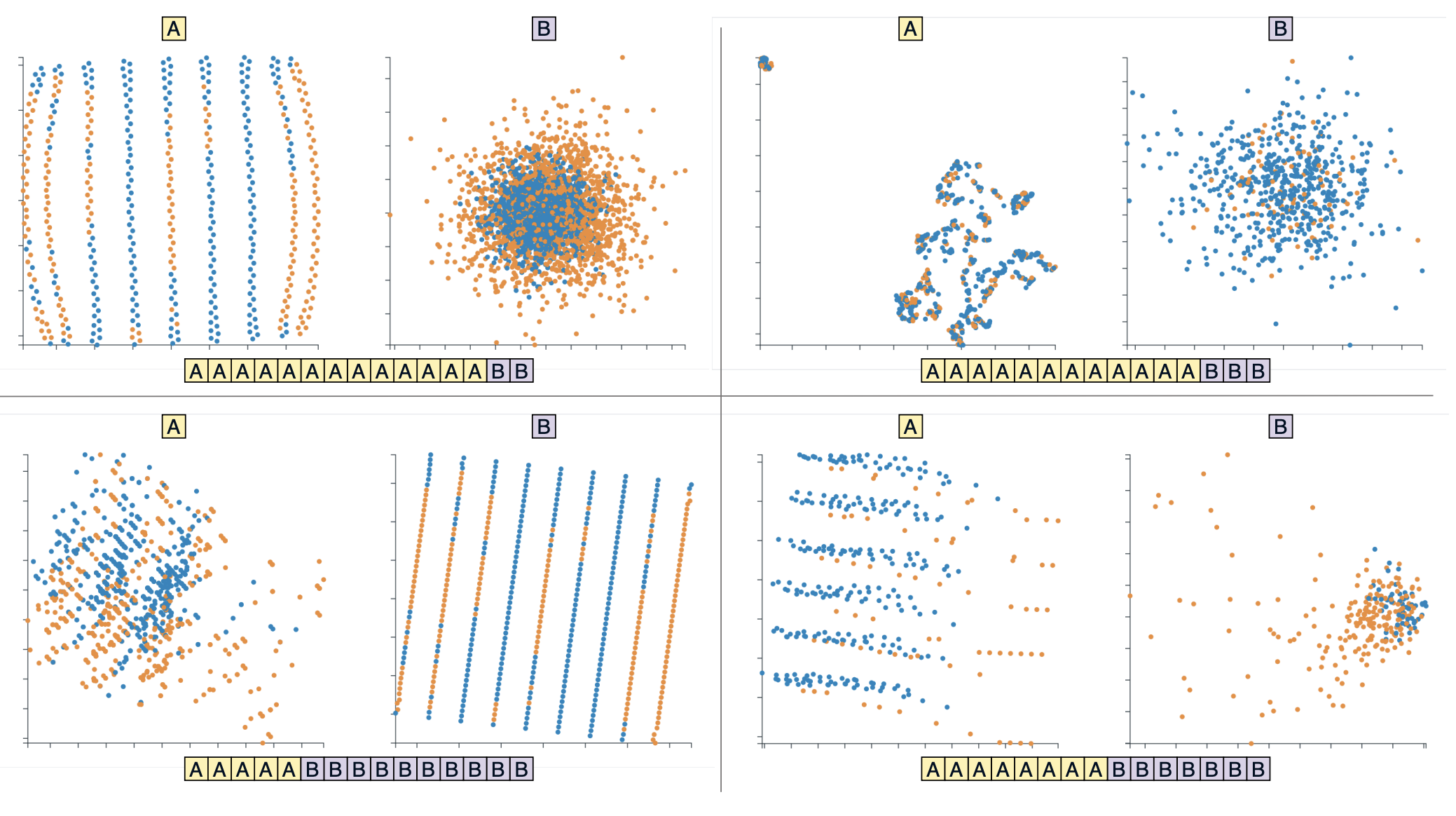
This work investigates how data and scatterplot features influence people’s perception of visual class separation. By analyzing human judgments across thousands of real-world scatterplots and dozens of quantitative features, we identify which factors most strongly affect perceived separability. The paper also introduces a composite feature model that better aligns with human perception than existing visual class separation metrics.
Graphical Perception of Icon Arrays versus Bar Charts for Value Comparisons in Health Risk Communication
Jade Kandel*, Jiayi Liu*, Arran Zeyu Wang, Chin Tseng, Danielle Szafir (*equally contributed)
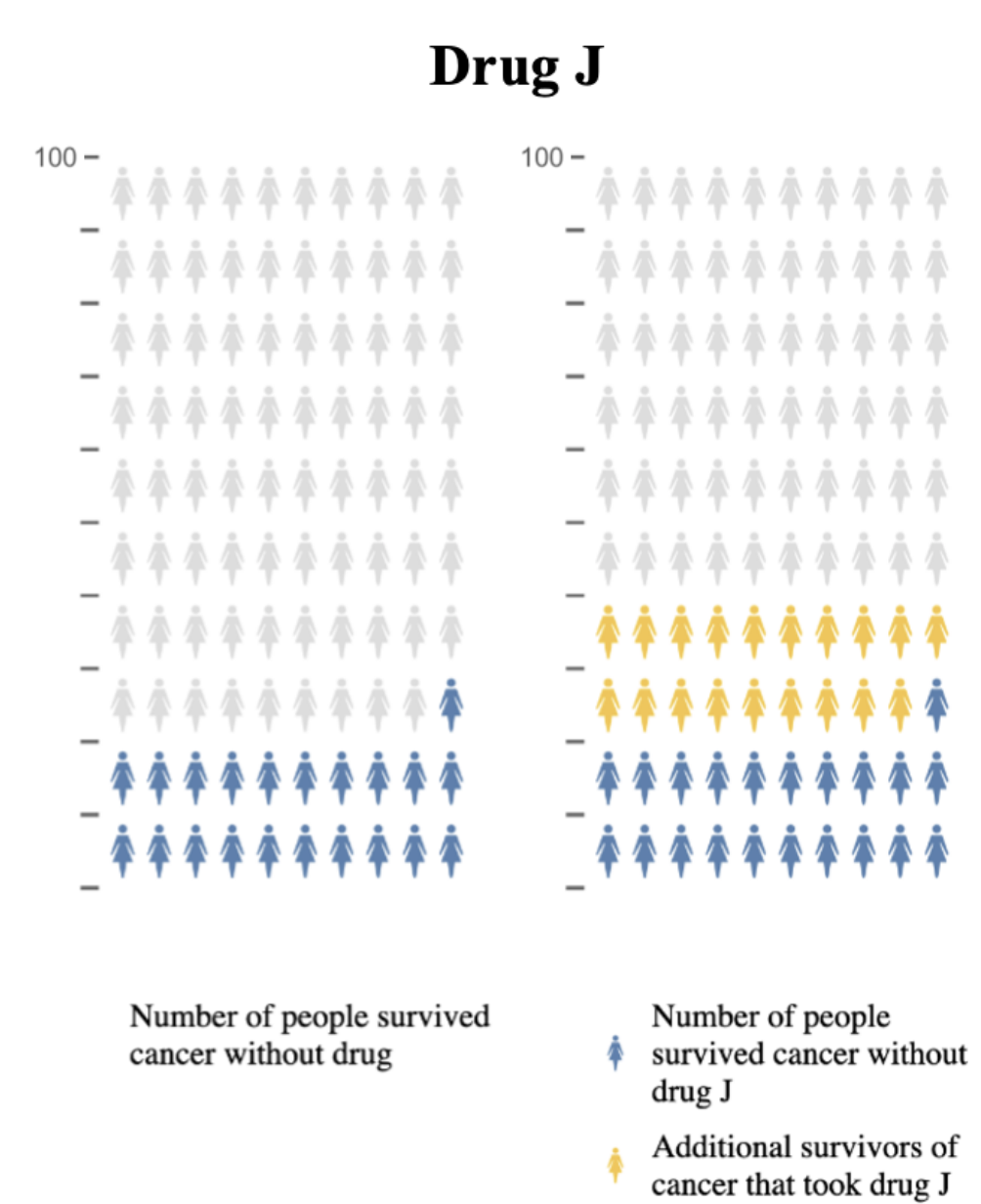
This paper compares icon arrays and bar charts for supporting value comparison and decision-making in health risk communication. Through two controlled experiments, we reveal trade-offs between estimation accuracy and decision outcomes, as well as differences across literacy levels. The results yield empirically grounded design recommendations for more effective and equitable risk communication.